EN



A kitchen scale purchase decision starts with one question that most buyers skip: what do you actually weigh? A home baker measuring 500g of flour per batch has fundamentally different requirements than a meal-prepper portioning 150g of chicken breast, and both differ from a coffee enthusiast weighing 15g of beans per cup. The scale's capacity, precision, and feature set should match the primary use case, not the most extreme scenario.
The capacity-precision trade-off is physical, not marketing-driven. A load cell designed for 5kg maximum capacity with 0.1g readability has a measurement range spanning 50,000 displayed increments. A load cell for 2kg with 0.01g readability spans 200,000 increments — four times the resolution. The engineering cost of maintaining 0.01g precision across a wider measurement range scales non-linearly, which is why high-precision kitchen scales cap at 2–3kg while general-purpose scales extend to 5–10kg. Choose the scale that optimizes precision in your most common weighing range.
A meal-kit delivery company standardized on a single kitchen scale model across 12 regional preparation kitchens after testing five candidates against their operational requirements. The selected scale — a 5kg/0.1g model with stainless steel platform and waterproof construction — handled the range from 5g herb packets to 2kg bulk ingredient bins without switching between different scales. The waterproof design proved unexpectedly valuable: scales were rinsed between production runs rather than wiped, reducing cross-contamination risk between allergen-containing and allergen-free meal kits. ACCT's K1913-B waterproof kitchen scale addressed this specific operational need.
Baking demands a kitchen scale with smooth tare functionality and a platform large enough to accommodate mixing bowls. The baker's workflow — place bowl on scale, tare, add first ingredient to target weight, tare, add second ingredient — repeats the tare cycle 5–10 times per recipe. The scale must respond to tare commands within one second and stabilize new readings equally quickly, or the workflow stutters.
Platform size matters more for baking than for any other kitchen scale application. A 19×16cm platform accommodates most mixing bowls with stable placement; smaller platforms require careful bowl positioning to prevent tipping when ingredients are added. The platform edge should extend slightly beyond the scale body to allow bowls wider than the base to sit stably.
The 0.1g precision standard is adequate for baking where most ingredient quantities exceed 3g. The exception is yeast and salt measurement for small-batch bread, where 0.1g resolution at the 3–7g range provides sufficient accuracy for consistent fermentation. Bakers requiring sub-gram precision for spices and additives in large-scale production should consider a separate 0.01g scale for those specific measurements.
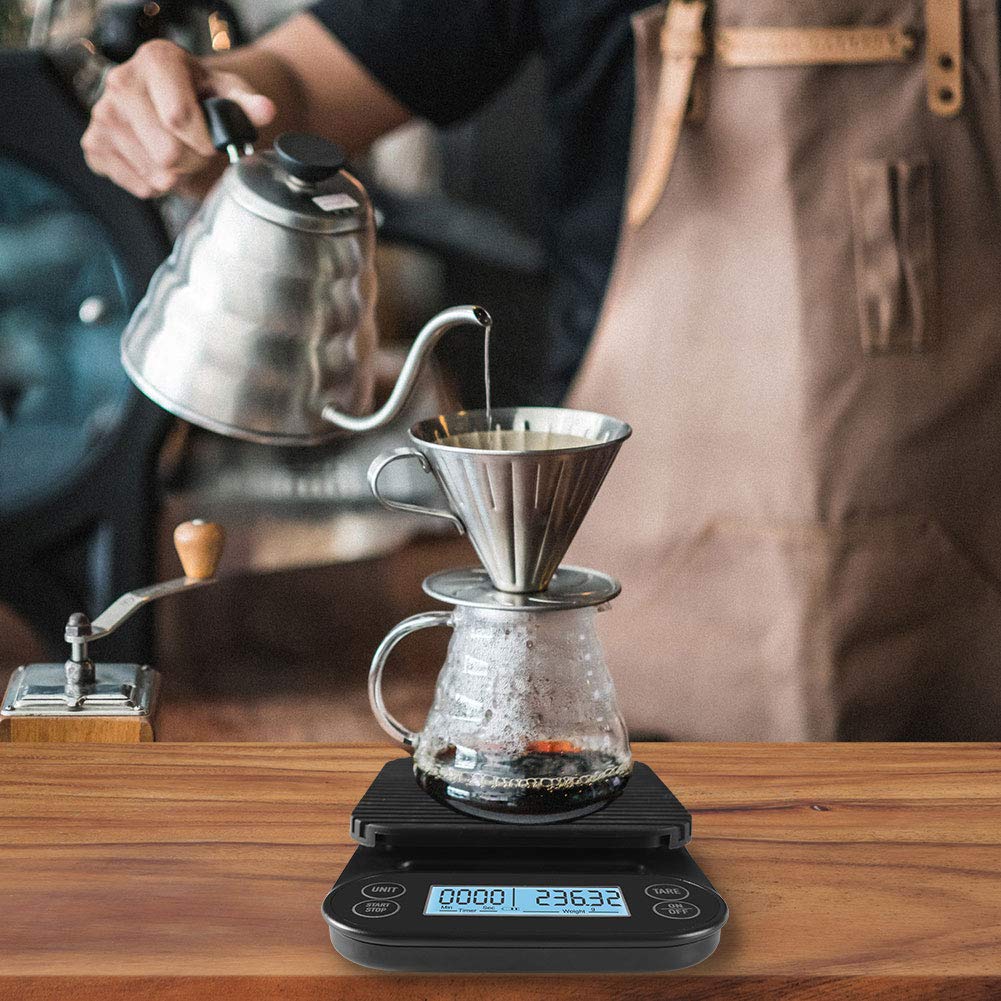
Coffee brewing with a pour-over or French press method requires simultaneous weight and time tracking. The pour-over workflow — wet the filter, tare, add grounds to target weight, tare, start pour while watching accumulated water weight and elapsed time — splits attention between scale display and timer. A scale with built-in timer eliminates the separate timer device.
The 0.1g precision on a 2kg-capacity coffee scale resolves the 0.1–0.2g variations that affect extraction when dosing 15–25g of coffee. The 1:15 to 1:17 brew ratio means a 1g error in coffee weight requires a 15–17g compensating water adjustment — precision at the coffee weighing stage cascades through the entire brewing process. ACCT's CS-13 coffee scale integrates 0.1g precision with a built-in timer specifically for pour-over workflow.
General cooking applications — portioning ingredients, weighing produce, dividing bulk purchases — prioritize capacity and durability over sub-gram precision. A 5kg capacity handles most ingredient quantities except bulk flour bags and large roasts that exceed the platform's practical measurement range. The 0.1g resolution is more than adequate for cooking where ingredient variations of a few grams have negligible impact on most dishes.
3–5kg covers 95% of home cooking and baking tasks. A 5kg capacity accommodates large mixing bowls with ingredients without approaching the maximum limit. Scales measuring up to 10kg suit bulk food preparation. ACCT's K2018 offers 5kg/0.1g in a compact format suitable for most kitchens.
Waterproof construction allows rinsing under running water — practical for scales used with wet ingredients, raw meat weighing, and sticky spills (honey, syrup, batter). Non-waterproof scales require careful wiping that may not fully clean crevices. ACCT's K1913-B waterproof scale includes a removable stainless steel bowl.
Rechargeable lithium batteries eliminate the recurring battery purchase cost (5–10 annually) and the environmental impact of disposable batteries. Battery-powered scales offer instant replacement when depleted versus the rechargeable's 1–2 hour charging downtime. Both last 3,000+ weigh cycles on a charge/set.
Large backlit displays reduce reading errors in dim kitchen lighting and when bowls obscure overhead light. The 1.5-inch LED display with 180° viewing angles on ACCT's K2018 remains readable from any standing position. Backlight is essential for scales used in evening cooking or under-cabinet locations.
Yes, if it offers 0.1g precision with a 2–3kg capacity. The scale handles coffee dosing (15–25g) and baking measurements (100–500g+). A dedicated coffee scale with timer adds workflow convenience but is not essential — a separate timer or phone app achieves the same result at zero additional cost.
A solid, level countertop away from the stove (heat causes thermal drift in the load cell) and away from appliance vibrations (refrigerator compressor cycling, dishwasher operation). Granite and solid-surface countertops provide the most stable base; lightweight tables transmit footstep vibration to the scale.
Shenzhen ACCT Electronics provides professional OEM/ODM electronic scales (pocket, kitchen, bathroom, postal) for global B2B clients. 20+ years’ experience, ISO9001 & CE/RoHS certified, 8M pcs/year capacity. Trusted by EU & NA partners. Request quote today.