EN



A mini balance is not simply a small scale. The term "balance" in precision measurement refers to an instrument that compares an unknown mass against a known reference — either through an electromagnetic force restoration mechanism in digital balances or through direct mass comparison in traditional beam balances. The distinction matters because balances achieve precision that strain-gauge scales cannot: 0.001g readability is standard, 0.0001g is accessible, and measurement uncertainty is specified rather than assumed.
The electromagnetic force restoration (EMFR) sensor in a digital balance operates differently than a strain gauge load cell. When weight is placed on the pan, the sensor coil, suspended in a permanent magnetic field, displaces slightly. A position detector measures this displacement, and the control circuit drives current through the coil to generate an opposing electromagnetic force that returns the pan to its null position. The current required to maintain the null position is proportional to the applied weight — a force-balance measurement that inherently provides better linearity and resolution than the open-loop deflection measurement of strain gauge sensors.
A gemologist evaluating loose stones for a jewelry wholesale business replaced a 0.01g pocket scale with a 0.001g mini balance from ACCT Electronics after a valuation discrepancy involving a 0.35-carat emerald. The pocket scale rounded the stone's weight to 0.1g, while the balance measured 0.070g. The difference represented approximately $45 in valuation at the stone's per-carat price — a single transaction error that exceeded the cost difference between the two instruments. The balance's protective windshield also eliminated the draft-induced reading fluctuations that had previously required waiting 15–20 seconds for stabilization on each measurement.
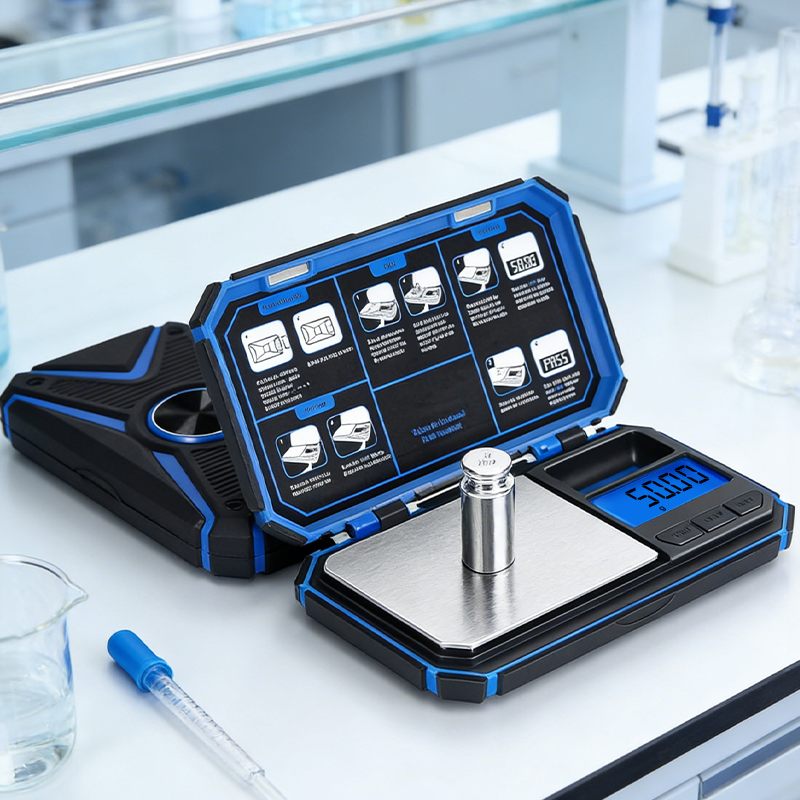
A mini balance achieves its compact form — units like ACCT's KL4 measure 10×8.8×2.7cm — through the same EMFR sensor principle used in full-size laboratory balances, miniaturized for portability. The trade-off for the compact form is a lower maximum capacity (50–200g) compared to laboratory balances that may handle 200–500g in benchtop configurations. The precision is comparable: 0.001g readability meets the requirements for jewelry, pharmaceutical compounding, and analytical sample preparation.
The calibration weight included with mini balances is not an optional accessory; it is essential for maintaining accuracy after transport. EMFR sensors, while inherently more linear than strain gauge cells, still require periodic recalibration because the magnet's field strength drifts slightly with temperature and age, shifting the current-to-weight relationship. ACCT's KL4 balance includes a 20g calibration weight; the K1918-B includes a 50g weight — both designed for the specific balance's calibration routine.
The transparent windshield included with precision balances is not cosmetic. At 0.001g sensitivity, the balance detects the pressure of air currents that are imperceptible to human senses. A person exhaling near an unprotected 0.001g balance produces a measurable weight fluctuation because the exhaled breath creates a momentary pressure differential across the weighing pan. Placing a warm hand near the pan creates thermal air currents that register as negative weight readings as rising warm air lifts the pan slightly.
The windshield creates a still-air chamber around the weighing pan, extending the balance's usable precision from laboratory environments into field and workshop settings. The windshield must be closed during measurement and opened only for loading — a workflow discipline that takes approximately five measurements to internalize. The 15–30 seconds required for the pan environment to stabilize after closing the windshield is the practical cycle time limitation for high-throughput weighing operations.
Piece counting — determining the number of identical small items by weighing a known sample quantity — is a productivity feature built into most digital balances. The operator places a known quantity of items (e.g., 10 screws) on the pan, the balance calculates the average piece weight, and subsequent weight measurements display as piece count rather than weight. The accuracy of piece counting depends on the individual items having consistent weight — manufacturing tolerance on small hardware typically varies 2–5%, which accumulates proportionally with count.
A balance uses electromagnetic force restoration (EMFR) for inherently better linearity than strain gauge scales. Balances achieve 0.001g readability as standard; pocket scales typically offer 0.01g. Balances include windshields for draft protection. Pocket scales are lighter and more portable for non-critical measurements.
The balance registers air pressure changes at 0.001g sensitivity. HVAC airflow, breath, and body heat near the pan create measurable weight fluctuations. The windshield creates still air for stable readings. ACCT's KL4 and K1918-B include transparent windshields for draft protection.
Place the balance on a level surface, allow 2–3 minutes warm-up, access calibration mode (typically holding the unit button), place the included calibration weight when prompted, and wait for the confirmation display. The entire process takes 30–60 seconds. Calibrate after transport, temperature changes, or monthly with regular use.
The minimum reliable measurement is 0.003–0.005g (3–5 × readability). Individual readings below this threshold may display values but repeat poorly. For items weighing 0.001–0.003g, average multiple measurements to improve confidence in the mean value.
Calibration weight, stainless steel weighing pan, tweezers for handling small items, and a 2-in-1 spoon/spatula for powder handling. A protective carrying case protects the balance during transport. ACCT's K1918-B includes the complete toolkit.
Yes, with a suitable container and tare workflow. Place the empty container on the pan, tare to zero, then add the sample. For powders, use the included tray or spoon to avoid spilling onto the pan surface. The windshield remains closed except during loading to maintain environmental stability.

Shenzhen ACCT Electronics provides professional OEM/ODM electronic scales (pocket, kitchen, bathroom, postal) for global B2B clients. 20+ years’ experience, ISO9001 & CE/RoHS certified, 8M pcs/year capacity. Trusted by EU & NA partners. Request quote today.