EN



A digital pocket scale capable of 0.01g or 0.001g readability transforms how small items are measured. When weighing a 0.5-carat diamond (0.1g), the difference between a scale reading 0.09g and 0.11g represents a 20% valuation error that would be unacceptable in any commercial transaction. For herbal supplements, a 0.02g dosing error on a 0.1g serving is proportionally equivalent to a 100g error on a 500g kitchen measurement — small absolute numbers mask large relative errors.
The precision requirement for small items is not about decimal places for their own sake. A digital pocket scale with 0.001g readability measures the minimum weight difference detectable by the load cell — typically 3–5 times the readability specification. A 0.001g scale can reliably detect weight changes of 0.003–0.005g, suitable for gemstone appraisal, pharmaceutical powder measurement, and precious metal verification where fractions of a gram carry significant financial or safety implications. The scale choice between 0.01g and 0.001g depends entirely on the smallest weight requiring reliable measurement.
A jewelry maker in Southeast Asia selling handcrafted silver earrings on Etsy adopted a 0.001g digital pocket scale from ACCT Electronics after postal weight discrepancies triggered three shipping surcharge notices in two months. The previous 0.1g kitchen scale rounded each earring's weight inconsistently — 4.2g reading as 4g, 4.8g as 5g — creating the 0.6–0.8g errors that pushed some packages into the next postal rate bracket. The new scale's 0.001g resolution eliminated rounding errors entirely, saving approximately $35 monthly in shipping overcharges.
The sensor inside a pocket scale is a strain gauge load cell — a precisely machined metal element with bonded resistive strain gauges arranged in a Wheatstone bridge circuit. When weight is applied to the platform, the metal element deforms microscopically, changing the electrical resistance of the strain gauges proportionally to the applied force. The bridge circuit converts this resistance change to a voltage signal, which the analog-to-digital converter (ADC) digitizes and the microcontroller converts to a weight reading.
The load cell's temperature compensation is critical for portable scales that move between environments. Strain gauge resistance changes with temperature separately from weight-induced changes, creating measurement drift if uncompensated. Quality load cells include a second set of strain gauges in the bridge circuit that experience the same temperature but not the same mechanical strain, canceling the temperature effect at the circuit level before the ADC samples the signal.
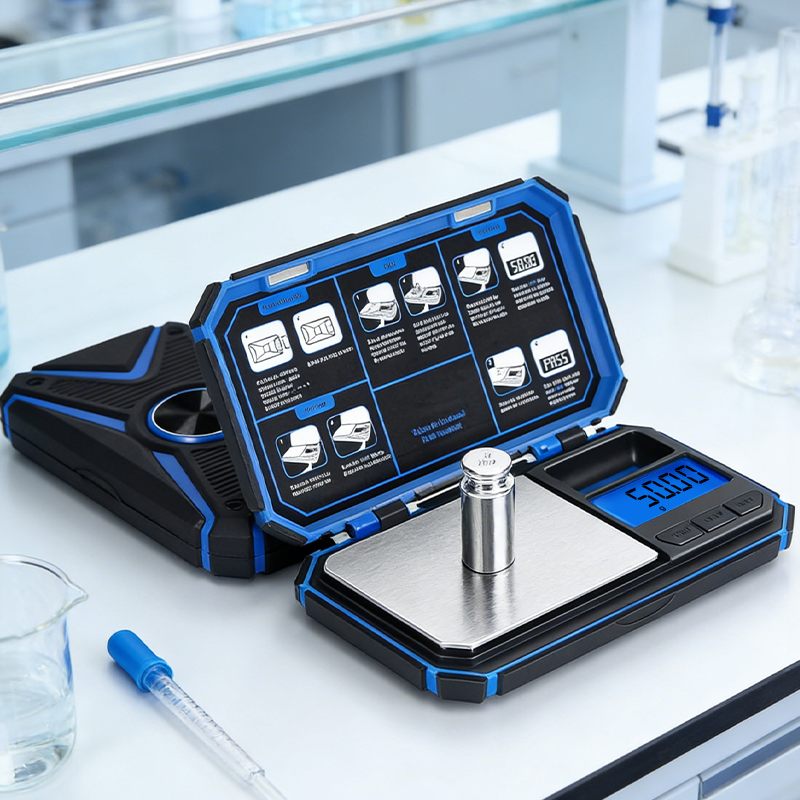
Pocket scales require periodic calibration because the load cell's zero point and sensitivity drift over time due to mechanical stress, temperature cycling, and component aging. ACCT pocket scales include calibration weights — 20g or 50g depending on model — that provide the known reference mass for recalibration. The calibration procedure is typically a two-point process: the scale records the zero-load reading, then records the reading with the calibration weight applied, calculating the linear correction factor that maps sensor output to displayed weight.
Air currents present the most significant environmental interference for sub-0.01g measurements. A draft from an air conditioning vent or a person walking past the scale creates pressure fluctuations that the sensitive load cell registers as weight changes. The protective covers and windshields included with precision balances address this by creating a still-air environment around the weighing pan. ACCT's K1918-B and KL4 models include transparent windshields specifically for draft protection during sub-0.01g measurements.
A 0.01g scale displays to two decimal places and reliably measures items above approximately 0.05g. A 0.001g scale displays to three decimal places and reliably measures items above 0.005g. The 0.001g resolution is necessary for gemstones, fine jewelry components, and pharmaceutical dosing where 0.01g errors are unacceptable. ACCT offers both precision levels across BIO, CS-E, and K1918-B models.
Yes. Quality pocket scales include multiple weighing units — grams (g), ounces (oz), troy ounces (ozt) for precious metals, carats (ct) for gemstones, pennyweights (dwt) for jewelry, and grains (gn) for ammunition reloading. The unit button cycles through modes without requiring manual conversion. ACCT pocket scales support up to 6 specialized units.
Calibrate when first received, after any physical impact or drop, when moving to a different temperature environment, and every 1–3 months with regular use. Most ACCT pocket scales include a calibration weight and the calibration procedure takes approximately 30 seconds.
Uneven surface (scale not level), air currents from fans or ventilation, temperature changes between calibration and use, low battery voltage affecting ADC reference, and overload beyond maximum capacity. Place the scale on a stable, level surface away from airflow for consistent readings.
Two AAA batteries typically last 500–1,000 weigh cycles depending on display backlight usage. ACCT scales include auto-shutoff after 60–180 seconds of inactivity. The low-battery indicator appears when voltage drops below approximately 2.2V.
The minimum reliable measurement is approximately 3–5 times the readability specification. A 0.001g scale's minimum is approximately 0.003–0.005g. Items lighter than this threshold may not register or will show inconsistent readings due to the load cell's noise floor.

Shenzhen ACCT Electronics provides professional OEM/ODM electronic scales (pocket, kitchen, bathroom, postal) for global B2B clients. 20+ years’ experience, ISO9001 & CE/RoHS certified, 8M pcs/year capacity. Trusted by EU & NA partners. Request quote today.