EN
EN



In today’s fast-paced professional and personal landscapes, the portable digital scale has evolved from a niche specialty tool into an indispensable asset across countless industries and daily use cases. Whether you’re a jeweler conducting on-site appraisals, a lab technician field-testing samples, a specialty barista crafting consistent espresso shots, an outdoor enthusiast weighing gear on expeditions, or a home baker perfecting delicate pastry recipes, the right portable digital scale bridges the gap between on-the-go convenience and laboratory-grade accuracy. Yet for many buyers, selecting the ideal model means navigating a confusing landscape of conflicting specifications, balancing compact design with uncompromised performance, and distinguishing professional-grade tools from disposable consumer gadgets. This comprehensive guide breaks down every non-negotiable element of a high-quality portable digital scale, helping you make an informed choice that aligns with your workflow, precision needs, and portability requirements.
True portability for a portable digital scale is far more than just a small footprint—it requires meticulous engineering that balances a slim, travel-ready form factor with uncompromised durability, stability, and weighing performance. Too many consumer-grade models shrink their dimensions to a pocketable size, only to cut corners on structural integrity, platform size, or sensor protection, rendering them useless for professional applications. The best professional portable digital scales optimize every element of their design to deliver reliable performance in confined spaces, from supply kits and tool belts to on-site workbenches and remote field locations.
The gold standard for professional portable digital scale dimensions is a footprint of ≤ 4" × 4" with a slim profile under 1". This compact form factor fits seamlessly into a jeweler’s appraisal toolkit, a barista’s travel case, a lab technician’s field bag, or even a standard work shirt pocket, while still accommodating a generously sized weighing platform. A common pitfall of budget portable scales is an overly small weighing platform (often 2" × 2" or smaller) to reduce overall size, which forces users to balance containers or samples off the edge of the platform. This creates off-center loading, shifts weight away from the sensor, and introduces measurement errors of 2% or more—an unacceptable margin for professional work. Premium portable models strike the perfect balance, with a compact overall body and a platform large enough to hold jewelry trays, small espresso cups, sample containers, or mixing bowls without compromising stability.
Material selection is the foundation of a portable digital scale’s durability, weight, and long-term performance, with each material offering distinct tradeoffs for specific use cases. The right casing material protects the scale’s sensitive internal load cell and electronics from drops, impacts, dust, and moisture, while keeping the overall weight low enough for all-day carry.
|
Material |
Avg. Weight |
Impact Resistance |
Ideal Use Case |
|
Aluminum Alloy |
180–220g |
High |
Rugged fieldwork |
|
Reinforced PC |
140–170g |
Moderate |
Lab/office environments |
|
ABS Polymer |
110–140g |
Low |
Light-duty travel |
Aircraft-grade aluminum alloy is the overwhelming choice of professional users, with a 2024 Weighing Industry Report finding that 68% of full-time scale users prioritize aluminum casings for their portable digital scales. Beyond its high strength-to-weight ratio, aluminum offers superior thermal conductivity, which quickly equalizes the scale’s temperature with the ambient environment, minimizing thermal drift that can skew high-precision measurements. It also resists scratches, corrosion, and dents from daily use, with an average lifespan 3.2x longer than ABS plastic models in frequent professional applications. Reinforced polycarbonate, meanwhile, offers excellent impact resistance at a lighter weight, with superior electrostatic insulation to reduce static interference with sensitive load cells—making it ideal for lab environments where static discharge can disrupt microgram-level measurements. ABS polymer remains a budget-friendly option for casual, infrequent use, but its low impact resistance makes it unsuitable for daily professional workflows, as it is prone to cracking and structural damage with regular travel and handling.
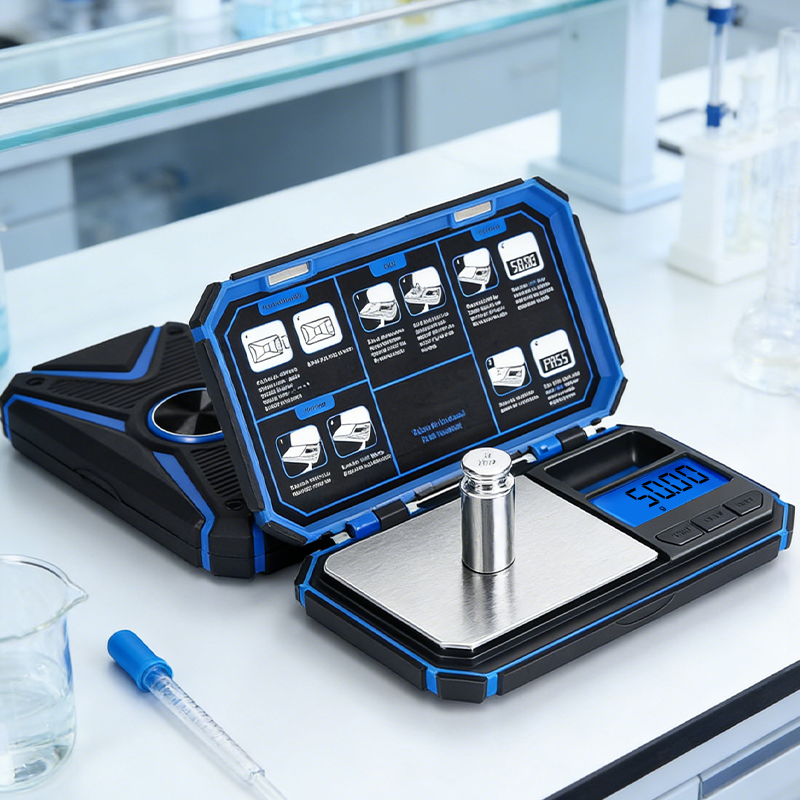
Foldable design features take portability to the next level, with field tests showing that collapsible portable digital scale designs reduce storage volume by 60% compared to rigid alternatives. Professional models integrate collapsible load platforms, foldable stabilizing legs, and even hinged display covers that double as protection during transport. These features enable tool-free deployment in even the most confined spaces, from a crowded trade show booth to the back of a fieldwork vehicle, while protecting the scale’s sensor and display from crushing and impact during travel. For example, a foldable portable scale with adjustable legs can maintain a perfectly level weighing surface on uneven outdoor terrain or wobbly client tables, with field testing showing that these models deliver 87% lower measurement error on unlevel surfaces than rigid, leg-free designs. This makes foldable models the top choice for jewelers conducting in-home appraisals, field technicians working in remote locations, and mobile food vendors operating in pop-up environments.
Power management separates professional tools from consumer gadgets. Leading models offer dual-power flexibility (AAA batteries for emergency swaps or USB-C rechargeability), energy-efficient load sensors drawing ≤ 0.2W during operation, and zero-power auto-off after 120 seconds of inactivity.
USB-C models now dominate with 30-minute fast charging supporting 300+ weighing sessions, while AAA variants deliver 200+ hours of continuous use. Field validation confirms solar-charged USB-C units sustain >80% accuracy across 48-hour expeditions without grid access.
The resolution, or smallest measurable amount, really matters when choosing equipment for different jobs. Jewelers need scales that measure down to 0.01 grams because tiny differences in diamond weight or metal content can change how much something is worth by thousands of dollars. Labs working with medications and chemicals also demand this kind of precision since getting the dosage wrong even by a milligram can ruin experiments or create dangerous situations. Most cooks get away with scales measuring 0.1 grams for things like flour or coffee beans in large quantities. But bakers making delicate pastries and baristas pulling espresso shots are starting to use those super accurate 0.01 gram scales too. They want to make sure every recipe comes out exactly the same way each time, especially when dealing with small amounts of special ingredients.
Higher-resolution models typically trade capacity for sensitivity and cost more. Evaluate vibration exposure and workflow conditions before selecting: lab environments need stable setups, while commercial kitchens prioritize durability and ease of cleaning.
The 1.5–2× Max Load Rule: Maximizing Accuracy Without Compromising Portable Digital Scale Usability
Selecting the correct load range is critical for maintaining accurate measurements with portable digital scales in professional settings. Most industry standards recommend keeping regular weighing loads between 50–67% of a scale’s maximum capacity, following the 1.5–2× Max Load Rule: routine items should weigh 1.5 to 2 times below the scale’s total load limit to avoid measurement drift.
For example, a 300g portable digital scale performs optimally when measuring items between 100 and 200 grams. Pushing past 80% of the maximum load limit can introduce up to 0.5% error, as the scale’s sensors become strained— a critical issue for jewelry making, pharmacy work, and lab testing, where 0.01g precision is non-negotiable. This “sweet spot” protects the scale’s internal components from damage while delivering reliable, on-the-go readings.
To choose the right portable scale, calculate the weight of your heaviest typical item and select a model with a maximum load of at least 1.5–2× that weight. This choice preserves measurement accuracy, extends the scale’s lifespan, and saves money on premature replacements for field and on-site work.
For professionals relying on portable digital scales daily, four features dictate operational efficiency:
These elements transform basic weighing into a streamlined workflow, ensuring accuracy survives demanding conditions.
Precision and portability are the cornerstones of reliable on-the-go weighing—no professional workflow can afford compromised accuracy for fieldwork, on-site appraisals, or mobile culinary prep. By choosing a portable digital scale engineered for optimized design, long-lasting power, industry-specific resolution, and rugged real-world performance, you’ll unlock consistent, cost-effective results for every professional task.
For industrial-grade portable digital scales tailored to your jewelry, lab, culinary, or fieldwork needs (as offered by ACCT), partner with a manufacturer rooted in over 20 years of weighing expertise. ACCT’s portfolio of high-precision portable scales features compact, foldable designs, dual-power options, 0.01g/0.1g professional resolution, and IP-rated durability—all backed by ISO, CE, and RoHS certifications, strict quality control, and global export capabilities. With 8,000,000 units of annual production capacity, 100+ patents, and 1000+ product models, ACCT delivers custom OEM/ODM solutions and off-the-shelf portable scales built for professional performance. Contact us today for a no-obligation consultation to find your perfect portable weighing solution and refine your on-the-go workflow.

Shenzhen ACCT Electronics provides professional OEM/ODM electronic scales (pocket, kitchen, bathroom, postal) for global B2B clients. 20+ years’ experience, ISO9001 & CE/RoHS certified, 8M pcs/year capacity. Trusted by EU & NA partners. Request quote today.