EN
EN



For jewelry retailers, using scales without National Type Evaluation Program (NTEP) Class II or National Measurement Institute (NMI) approval risks significant legal and financial consequences. These certifications verify that a jewelry scale meets strict accuracy standards—typically ±0.005 carats—and undergoes annual recertification. Non-compliant scales used in transactions violate trade laws in most regions, exposing businesses to fines averaging $740,000 and invalidated sales contracts. Unlike general-purpose scales, NTEP/NMI-approved devices feature tamper-proof seals, audit trails, automatic unit conversion (grams/carats/troy ounces) per trade regulations, and calibration certificates traceable to national standards.
A common misconception equates high-precision scales with legal-for-trade compliance—a gap that costs retailers millions annually. While both may offer 0.001g readability, only certified scales pass rigorous testing for environmental interference (e.g., vibration, airflow) and transactional integrity. Consider these key differences:
| Feature | High-Accuracy Scale | Legal-for-Trade Scale |
|---|---|---|
| Regulatory Status | Not valid for sales | NTEP/NMI certified |
| Error Margin | ±0.003g (unregulated) | ±0.001g (audit-enforced) |
| Financial Risk | Contract disputes | Fines + sales invalidation |
Overlooking this distinction leads to 68% of measurement-related legal challenges, as non-certified units lack mandatory features like auto-calibration locks and transaction logging required for verifiable sales documentation.
A jewelry scale’s precision directly impacts valuation accuracy—a 0.01g discrepancy in gold can translate to $50+ in value fluctuations. For gemstones, 0.005ct readability is essential to detect weight differences affecting diamond grading. Conversely, 0.001g resolution suits precious metal weighing where milligram variations alter purity calculations. Industry data shows 78% of valuation errors stem from mismatched resolution-to-task pairings. For example:
| Use Case | Optimal Readability | Critical Tolerance |
|---|---|---|
| Diamond certification | 0.005ct | ±0.01ct |
| Gold scrap evaluation | 0.001g | ±0.002g |
Leading jewelry scales eliminate conversion errors by natively supporting troy ounces (precious metals), carats (gemstones), and grams (universal applications). This tri-mode functionality prevents costly miscalculations—a 2024 industry audit revealed that 62% of pawnshop disputes originated from manual unit conversions. Seamless toggling between units maintains workflow efficiency while ensuring compliance with measurement standards like the NIST Handbook 44. Units must be hardware-switchable to avoid accidental mode changes during transactions.
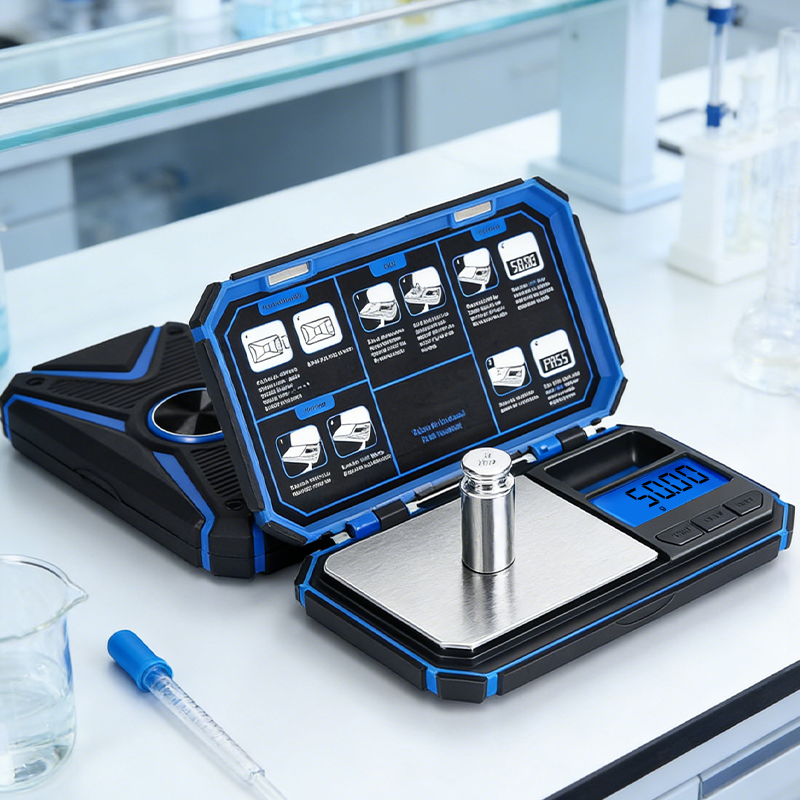
Pocket jewelry scales prioritize extreme portability for hobbyists and home gemologists, typically weighing items under 100g with 0.01g readability. Their compact size enables on-site appraisals or travel use, but this portability compromises stability—vibration or drafts often disrupt measurements. Avoid weighing near air vents or uneven surfaces, and always calibrate before critical measurements. Crucially, most pocket scales lack Legal-for-Trade certification, making them unsuitable for commercial transactions. For non-commercial use like jewelry crafting or collection tracking, their affordability and USB-rechargeable batteries offer practical convenience.
Retail environments demand compact and precision balances with enhanced stability features like internal calibration weights and draft shields, ensuring consistent 0.001g–0.005ct accuracy even in busy shops. These units support higher capacities (300g–2kg) for weighing multiple items or bulkier pieces like gold chains. Unlike pocket scales, professional models include mandatory NMI/NTEP approvals for commercial sales. Anti-theft cable locks, overload protection, and auto-tare functions streamline daily operations. According to industry standards, retail-focused scales must undergo annual verification to maintain compliance.
Legal-for-Trade certification ensures that a jewelry scale meets strict regulatory standards for accuracy and compliance, preventing legal and financial issues.
No, not all high-precision scales are Legal-for-Trade certified. Certified scales undergo rigorous testing for accuracy and compliance, while high-precision scales may not meet these regulatory requirements.
Key features include NTEP/NMI certification, tamper-proof seals, audit trails, automatic unit conversion, and calibration certificates traceable to national standards.
Pocket scales are highly portable but lack stability and Legal-for-Trade certification, making them unsuitable for commercial use. Precision balances offer higher stability, accuracy, and compliance, ideal for retail applications.
Jewelry scales should undergo annual recertification to maintain compliance with trade regulations and ensure accuracy.
Shenzhen ACCT Electronics provides professional OEM/ODM electronic scales (pocket, kitchen, bathroom, postal) for global B2B clients. 20+ years’ experience, ISO9001 & CE/RoHS certified, 8M pcs/year capacity. Trusted by EU & NA partners. Request quote today.