EN


Optimize Travel Luggage Scale Usage Effectively
A travel luggage scale is most useful before a trip becomes rushed: after you have packed realistically, but before you are standing at the check-in desk. As a portable-scale product specialist, I start with the carry context rather than a feature list. The question is not simply whether a travel luggage scale turns on. It is whether you can lift the bag safely, get a settled reading, and use that reading against the baggage allowance that applies to your own booking.
Portable does not automatically mean effortless. A heavy suitcase, a loose strap, or a reading taken while the bag is swinging can make a travel luggage scale harder to use. The good news is that a repeatable routine removes most avoidable uncertainty. This guide explains how to prepare, weigh, interpret, and recheck baggage with a travel luggage scale without treating a home reading as a guarantee of an airline’s final measurement.
Start with the allowance, not the scale
Before using a travel luggage scale, check the baggage terms for the flight you are taking. IATA notes that checked-baggage allowances and conditions remain airline-specific and can vary by route. Your itinerary may show a weight allowance, a piece allowance, or both. That is the starting point: a travel luggage scale helps you manage the limit you actually have, not a generic number remembered from another trip.
Write down three things: the maximum weight per checked bag, the number of bags included, and any cabin-bag rule relevant to your packing plan. If your journey involves more than one carrier, confirm the conditions shown for the ticket rather than assuming every segment is identical. Leave a modest buffer below the stated limit. A travel luggage scale is a useful packing tool, while the carrier’s check-in equipment and policy determine acceptance.
Set up the travel luggage scale before lifting
Choose a clear area and put the packed suitcase where you can attach the strap or hook without twisting it. Check that the travel luggage scale has enough battery power, that the display starts at zero, and that the selected unit matches the allowance you recorded. If the allowance is in kilograms, use kilograms; if it is in pounds, use pounds. Converting from memory at the last minute adds an unnecessary error source.
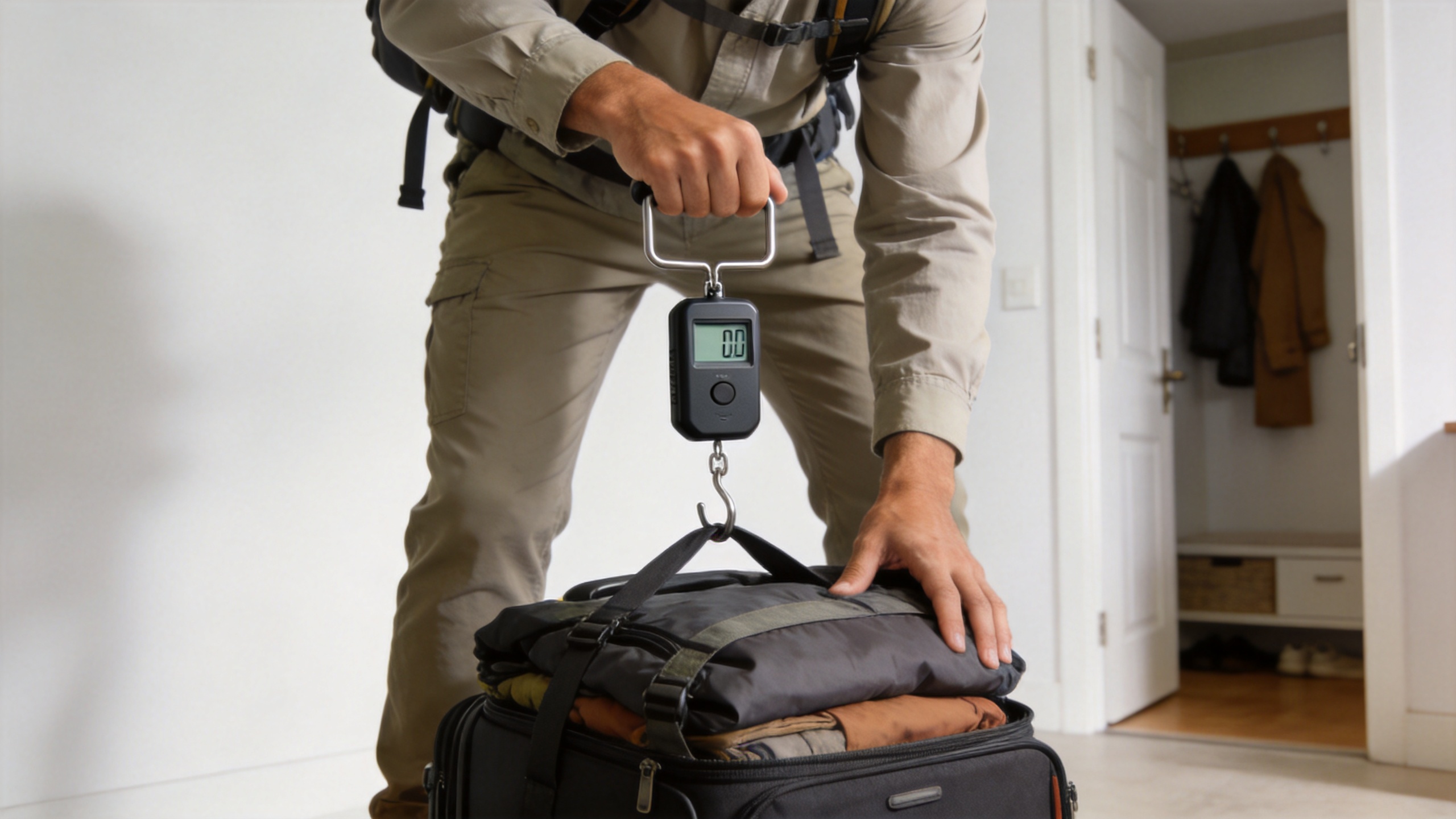
Inspect the attachment point. With a strap-style travel luggage scale, pass the strap through a sturdy suitcase handle and close it completely. With a hook-style model, make sure the hook is seated on the handle rather than caught on a zipper pull, tag loop, or loose fabric. Keep fingers away from the loaded connection. If the handle itself feels weak or the bag is too heavy for you to control, use a safer method or ask another person to help.
Use a repeatable weighing routine
- Pack the bag as it will travel. Include chargers, shoes, toiletries, and any items likely to stay in the checked suitcase. A travel luggage scale cannot help much if half the trip’s weight is still on the floor.
- Attach the scale to one secure handle. Keep the bag close to your body and your grip firm.
- Lift smoothly. Raise the bag only high enough for it to hang freely. Do not jerk the travel luggage scale upward or bounce the suitcase.
- Wait for the display to settle. A swinging bag produces a moving load. Hold still, look at the screen, and use the hold feature only if your model provides it.
- Lower the bag carefully and repeat. Take two or three readings with the travel luggage scale. Similar readings are more useful than a single hurried number.
This sequence matters because a travel workflow involves handling suspended baggage, not placing an object quietly on a platform. The most practical advice is also the simplest: lift in a controlled motion, wait for the suitcase to stop moving, and check the unit before you record the number.
How to interpret a travel luggage scale reading
A travel luggage scale gives you a decision aid, not a promise that every airport scale will display the same figure. Differences can come from the device, the way the bag is lifted, the handle position, the selected unit, and the check-in process. When the reading is comfortably below your confirmed limit, it can support your packing decision. When the reading is close to the limit, treat that closeness as a signal to repack rather than an invitation to debate fractions.
That is the starting point. The next question is whether the bag’s weight is stable across repeat checks. If one travel luggage scale reading differs sharply from the next, stop and inspect the setup. Is the strap centered? Is the bag touching the floor? Is the bag swinging? Has the unit changed? Repeat the measurement after correcting one condition at a time. Do not assume a displayed increment is a blanket accuracy promise; it is still important to use a controlled method.
Common mistakes that make readings less useful
Weighing an incomplete bag
Many travelers test a suitcase before adding the heaviest items. Use the travel luggage scale after final packing, then recheck whenever you move items between bags. A small change can matter when your margin is already narrow.
Letting the suitcase swing
A pendulum-like bag is difficult to read. Keep your arm steady, lift only as high as needed, and wait. If the luggage is awkward, a second person can steady the suitcase without taking the load off the travel luggage scale.
Ignoring the selected unit
One quick unit check prevents a simple mix-up. A travel luggage scale used in the wrong unit can lead to a correct-looking but unusable number. Record the measurement and its unit together.
Assuming one allowance fits every flight
Airline terms can vary by route, fare, and booking condition. Use the travel luggage scale alongside the allowance on your current booking, then check for updates before departure.
Build a pre-departure luggage check
The easiest way to get consistent value from a travel luggage scale is to make it part of a short pre-departure checklist. Pack fully, confirm the airline allowance, set the unit, attach the strap or hook securely, lift smoothly, wait for the display, repeat the measurement, and leave a buffer. If you are carrying two checked bags, label the recorded weight for each bag so the readings do not get mixed up during a busy packing session.
For families or teams, one person can read the travel luggage scale while another steadies the bag and writes down the result. That approach is not about making a precise performance claim; it is about making the process easier to repeat. If a bag is near the limit, move a few items, weigh again, and keep the confirmation focused on the airline’s own conditions.
Care and packing tips for a travel luggage scale
Keep the travel luggage scale dry, protected from hard impacts, and easy to reach before leaving for the airport. Store it where the strap, hook, and display are not pressed under heavy items. Before an important trip, turn it on and check the battery. Avoid using the travel luggage scale as a permanent carrying handle or loading it beyond the limits stated in its own instructions.
In short, a travel luggage scale works most reliably when it supports a calm routine: verify the ticket rules, prepare the bag, use a secure attachment, take repeat readings, and leave room below the limit. If you are selecting travel-scale options for resale or a product range, confirm the intended capacity, unit options, display behavior, handle design, and operating instructions for the exact configuration before presenting it as a final match.