EN
EN



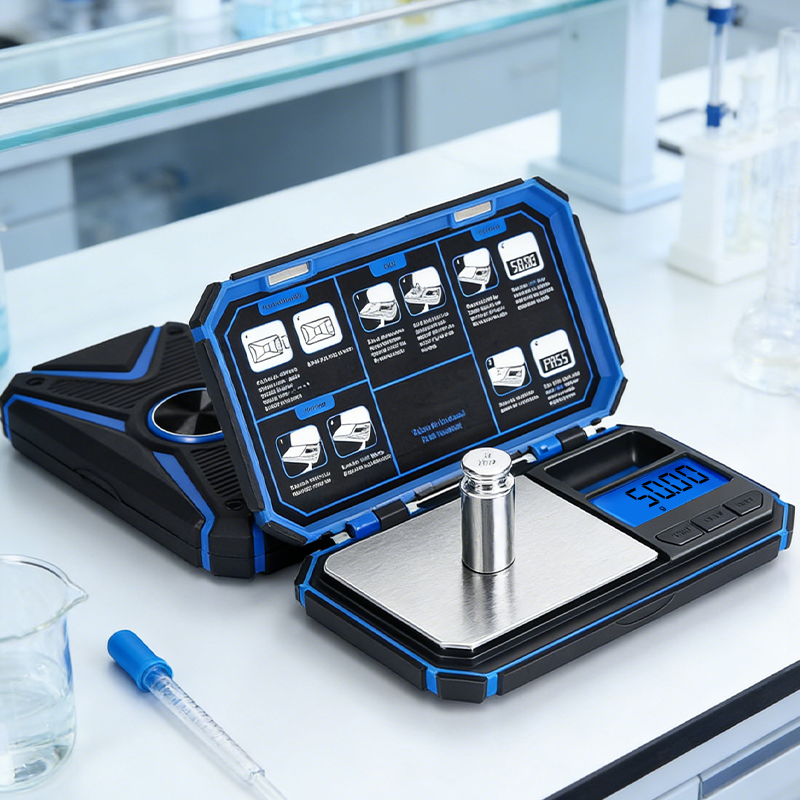
Jewelry scales require precision readability—typically ±0.01g to ±0.001g—to ensure accurate carat-to-gram conversions. Since 1 carat = 0.2 grams, a 0.01g error equals a 0.05-carat discrepancy—enough to misclassify a diamond across critical pricing thresholds (e.g., 0.99 ct vs. 1.00 ct). This directly affects valuation, especially for small gemstones where price per carat jumps exponentially at whole-carat boundaries.
Effective jewelry weighing demands a deliberate balance between capacity and resolution. While gold chains or ingots may require capacities up to 500g, their density allows acceptable tolerances at ±0.01g. In contrast, loose diamonds or pavé settings demand sub-0.01g sensitivity—even down to ±0.001g—to resolve fractional carats reliably. Using a single scale for both extremes risks significant drift: a device calibrated for 300g gold may introduce >0.03g uncertainty when weighing a 0.02g diamond setting. Specialized workflows—separate scales or mode-specific calibration—are therefore essential for mixed inventories.
NTLP Class II certification is mandatory for any jewelry scale used in commercial transactions involving precious metals or gemstones. It ensures compliance with legal-for-trade standards set by the National Type Evaluation Program, limiting permissible error to ±0.05g at 100g and scaling proportionally across capacity. Uncertified devices lack traceable metrological validation and expose businesses to regulatory penalties, voided sales, and liability in disputes. Certification requires annual verification against NIST-traceable weights, anchoring every measurement to national standards—and eliminating ambiguity in high-stakes valuations.
Environmental variables are among the most common sources of uncorrected error in jewelry weighing. As documented in NIST Interagency Report 1894, even minor disturbances degrade accuracy:
These effects compound rapidly—particularly with low-mass, high-value items like diamonds—making environmental controls (draft shields, anti-static mats, stable mounting surfaces) non-optional for reliable results.
Human factors account for the majority of avoidable inaccuracies in daily operations. Three errors consistently dominate root-cause analyses:
A simple pre-weighing checklist—including visual bubble-level verification and tare confirmation with an empty, clean tray—reduces these errors by over 80%, according to field data from NIST’s 2023 Jewelry Metrology Survey.
Calibration must be contextual—not calendar-based. Implement a tiered protocol aligned with operational risk:
Document each calibration with timestamp, weight used, environmental notes (temperature/humidity), and operator initials to support audit readiness and trend analysis.
Preventive maintenance is foundational—not supplemental—to jewelry scale reliability. Use Class F1 or F2 test weights matched precisely to your scale’s readability (e.g., 0.01g weights for carat-grade scales). Weekly routines should include:
Annual professional servicing validates internal mechanisms against NTLP Class II tolerances. Jewelers who adopted monthly verification reduced repeat-weight discrepancies by 89% compared to those relying solely on annual service, per a 2024 industry benchmark study.
A 0.05g drift—less than the weight of a grain of sand—translates into measurable financial loss at scale. The 2023 Perth Mint Audit found that uncertified or improperly maintained scales introduced this level of drift across 100g gold lots, resulting in a $2,400 valuation shortfall per lot. At current gold prices (~$70/g), that represents a 1.5% margin erosion—compounded across hundreds of lots annually. For diamonds, the impact intensifies: a 0.01g error in a 0.5ct stone (0.1g) equates to a 10% weight miscalculation—potentially triggering a $1,000+ discrepancy given today’s $10,000+/carat market rates. Precision isn’t theoretical—it’s profit protection.
Inaccuracy inflicts damage beyond spreadsheets—it fractures trust. When clients receive inconsistent valuations during insurance appraisals or consignment evaluations, they interpret variance as either technical incompetence or intentional undervaluation. In luxury markets—where 78% of buyers rank measurement precision as their top criterion for trust (Luxury Consumer Trust Index 2023)—a single disputed reading can end long-standing relationships. Collectors liquidating heirlooms, designers submitting pieces for hallmarking, or insurers validating claims expect metrological rigor—not approximation. Public disputes over weight discrepancies have derailed auction bids, triggered third-party forensic reviews, and triggered social media backlash—damaging brand equity far more permanently than any short-term margin gain.
NTLP Class II certification ensures legal compliance in commercial transactions involving precious metals and gemstones. It guarantees traceable metrological validation, reducing liability and disputes while anchoring accuracy to national standards.
Environmental factors such as drafts, vibrations, temperature fluctuations, and electrostatic charges can cause measurement errors. Proper controls like draft shields and anti-static mats help mitigate these issues.
Jewelry scales should be calibrated daily, per batch, and after relocation to maintain accuracy. Contextual calibration helps offset density-related load cell hysteresis and mechanical alignment shifts.
Even small inaccuracies, such as a 0.05g drift, can lead to significant financial loss in jewelry transactions—for example, a $2,400 shortfall in a 100g gold lot. Such errors also erode customer trust and brand reputation.
Routine maintenance, such as cleaning load receptors and verifying leveling, ensures reliable measurements. Preventive practices, professional servicing, and monthly verifications reduce discrepancies significantly.
Shenzhen ACCT Electronics provides professional OEM/ODM electronic scales (pocket, kitchen, bathroom, postal) for global B2B clients. 20+ years’ experience, ISO9001 & CE/RoHS certified, 8M pcs/year capacity. Trusted by EU & NA partners. Request quote today.